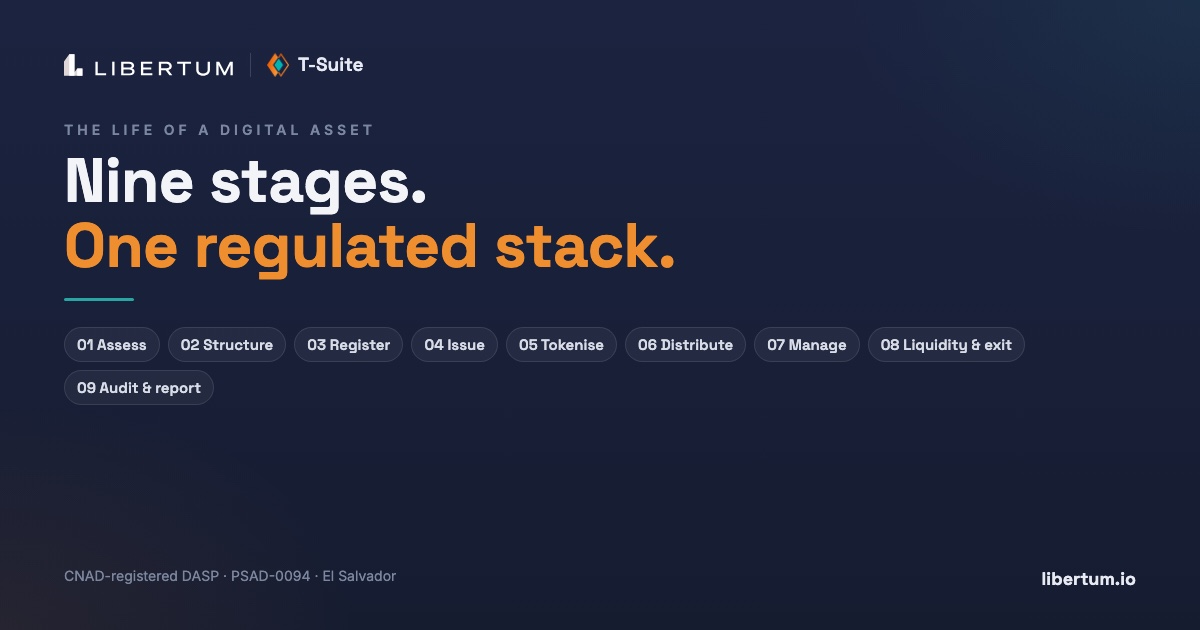
“Tokenising an asset” sounds like one event: a token gets minted, and that’s it. In practice, minting is stage five of nine. Before it come months of assessment, structuring and registration. After it, the asset has to be distributed, run, traded, redeemed and audited for years.
Most issuers assemble that journey from a different provider at every stage: a law firm, a token vendor, a custodian, a CRM, a registrar and a lot of spreadsheets. Each handover is a place where data is retyped, documents drift out of sync and investors wait.
We built Libertum to be one stack across the whole journey. It has two layers:
- Libertum is the regulated layer. Libertum, S.A. de C.V. is registered with El Salvador’s CNAD as a Digital Asset Service Provider (PSAD-0094), with custody of digital assets within its authorised scope. It runs the custodian wallets, maintains our compliance policies and reports to the regulator.
- T-Suite is the workflow layer. It’s the platform issuers use to move through every stage, under their own brand and on their own domain.
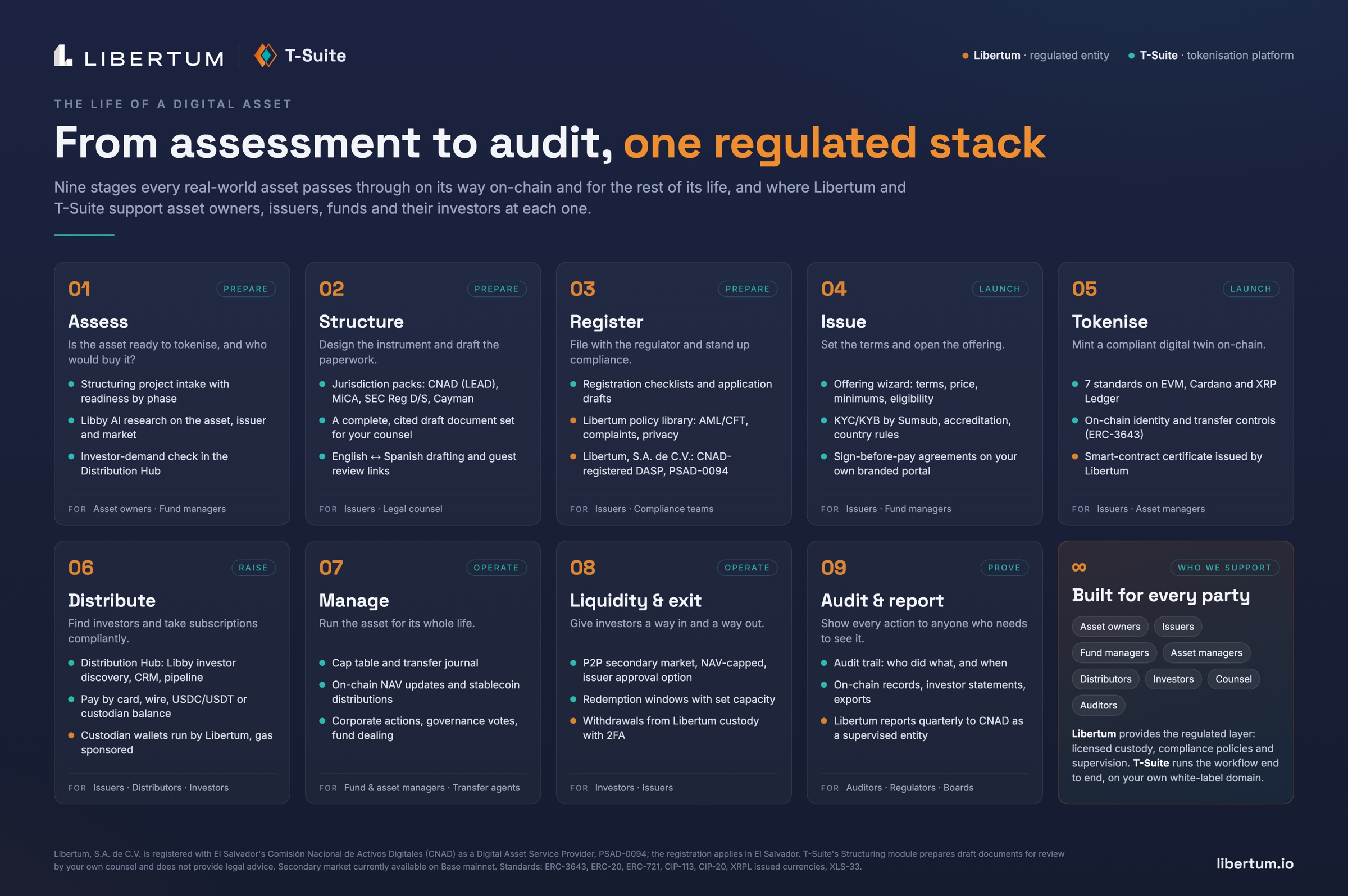
Prepare
1. Assess
Is the asset ready to tokenise, and who would buy it?
Every issuance starts with two questions: is this asset, and this issuer, ready? And is there demand for it? In T-Suite, a Structuring project answers the first. It shows readiness phase by phase and lists exactly what’s still missing. Libby, our AI analyst, researches the asset, the issuer and the market. The Distribution Hub answers the second: you can see which investors match the asset before you commit to a structure.
2. Structure
Design the instrument and draft the paperwork.
This is where most of the time and cost goes. T-Suite’s Structuring module is built on regulatory knowledge packs for El Salvador (CNAD/LEAD), the EU (MiCA), the US (SEC Reg D/Reg S) and the Cayman Islands. It walks you through what your framework requires, proposes answers from your own documents, and drafts the complete document set. Each answer is written once and reused, so the documents never contradict each other. You can draft in English and Spanish and share guest review links with advisers.
Structuring prepares drafts for your counsel to review. It does not give legal advice, and your lawyers stay in charge of the final documents.
3. Register
File with the regulator and stand up compliance.
Regulators want more than an offering document. They also want registration applications, sworn statements and the policies a regulated issuance runs on. T-Suite produces registration checklists and application drafts. Libertum’s own policy library covers AML/CFT, complaints, privacy and custody. And when your issuance names a licensed digital asset service provider, that’s Libertum, S.A. de C.V., registered with the CNAD as PSAD-0094.
Launch
4. Issue
Set the terms and open the offering.
The offering wizard captures terms, price, minimum and maximum tickets, and who may invest. Investor onboarding is built in:
- identity and business checks through Sumsub
- accreditation where your framework requires it
- country rules
- agreements that are signed before any money moves
It all runs on your own white-label investor portal, on your own domain.
5. Tokenise
Mint a compliant digital twin on-chain.
T-Suite supports seven token standards across three chain families:
| Chain family | Standards |
|---|---|
| EVM | ERC-3643, ERC-20, ERC-721 |
| Cardano | CIP-113, CIP-20 |
| XRP Ledger | Issued currencies, XLS-33 multi-purpose tokens |
For regulated securities, ERC-3643 enforces identity and transfer rules on-chain, so a token can only reach a verified, eligible holder. Every deployed contract receives a smart-contract certificate issued by Libertum. If you already have a token, you can bring it in with Token Import.
Raise
6. Distribute
Find investors and take subscriptions compliantly.
Tokenisation doesn’t create demand. Distribution does. The Distribution Hub gives your team a shared investor CRM, a capital pipeline and Libby AI. Libby finds investors that match your asset, researches them and drafts personalised outreach.
At checkout, investors can pay by card, bank transfer, USDC or USDT, or from their custodian balance. Custodian wallets are run by Libertum, and the network fees for custodian payments are sponsored, so investors never need to hold ETH to buy.
Operate
7. Manage
Run the asset for its whole life.
After issuance, the asset still has to be administered. T-Suite keeps the cap table and a transfer journal, publishes NAV updates on-chain and pays distributions in stablecoins. It also runs corporate actions such as freezes and forced transfers, governance votes and, for funds, subscription and redemption dealing.
8. Liquidity & exit
Give investors a way in and a way out.
Investors value an asset they can sell. T-Suite’s peer-to-peer secondary market caps resale prices at the current NAV and lets the issuer approve resales if they wish. It’s live on Base mainnet today. Redemption windows with set capacity give a structured exit. Withdrawals from Libertum custody are protected by two-factor authentication.
Prove
9. Audit & report
Show every action to anyone who needs to see it.
Auditors, regulators, boards and investors all need the same thing: evidence. T-Suite keeps an audit trail of who did what and when. On-chain records back every transfer. Investor statements and data exports are a click away. Libertum itself reports to the CNAD every quarter as a supervised entity.
Why one stack
Each handover between providers adds cost, delay and risk. The structuring answers have to be retyped into the offering. The offering has to be rebuilt on the token. The cap table has to be reconciled with the chain. When every stage runs on one platform, on one regulated foundation, the data moves forward with the asset instead of being rebuilt at every step.
That’s what we mean by one regulated stack: Libertum as the regulated layer, and T-Suite as the workflow, from the first assessment to the last audit.
Want to see where your asset sits on this map? Sign in to T-Suite or talk to our team.
Libertum, S.A. de C.V. is registered with El Salvador’s Comisión Nacional de Activos Digitales (CNAD) as a Digital Asset Service Provider, PSAD-0094; the registration applies in El Salvador. Issuers remain responsible for their own authorisations in the jurisdictions where they offer. T-Suite’s Structuring module prepares draft documents for review by your own counsel and does not provide legal advice. This article is for information only and is not an offer of any security or digital asset.