Stablecoin
A complete issuance platform: deploy a fully-backed token through audited contracts, run mint and redemption at par, and hold the reserve accounting that regulators, auditors, and your holders expect — in one place.
- Live today
- Cardano mainnet
- Backing classes
- Fiat, bonds, gold, crypto
- From
- $19.99 / month
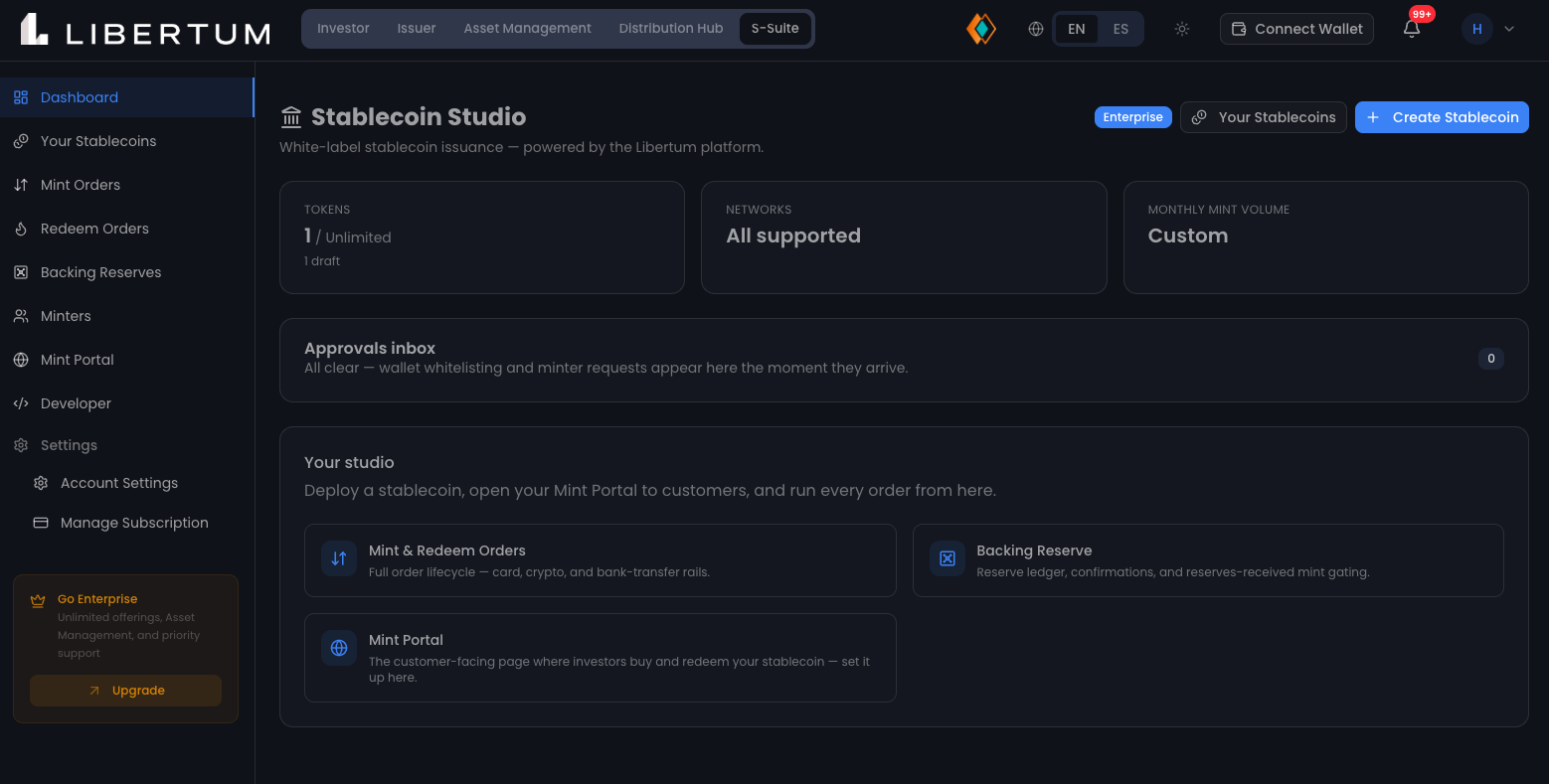
Anyone can mint a token. The hard part is everything that makes it worth its face value — segregated reserves, honest accounting, redemption that works, and controls a supervisor can inspect.
Libertum gives you that second part as a product. The token contract is the small piece; the reserve ledger, the mint and redemption lifecycle, custody, compliance rules, the customer-facing portal, and the audit trail are the platform.
How it works
From configuration to a live, backed token
- 01
Configure
Six steps: token basics, backing and reserve policy, compliance rules, supply mechanics, governance, review. Saved as a draft until you are ready.
- 02
Deploy
Issued through Libertum's existing audited stablecoin factory on your chosen network. No contract is written, redeployed, or forked for you.
- 03
Fund the reserve
Record deposits against bank, custody, or commodity accounts. Minting can be gated so no token exists before its backing is confirmed.
- 04
Open the Mint Portal
Your customers mint and redeem on your own branded domain, paying by wire, card, or stablecoin, with wallets whitelisted by you.
The product
A working console, not a landing page
Every screen below is the live platform. Issuance, reserves, orders, minters, and the developer API are one system with one audit trail.
Issuance
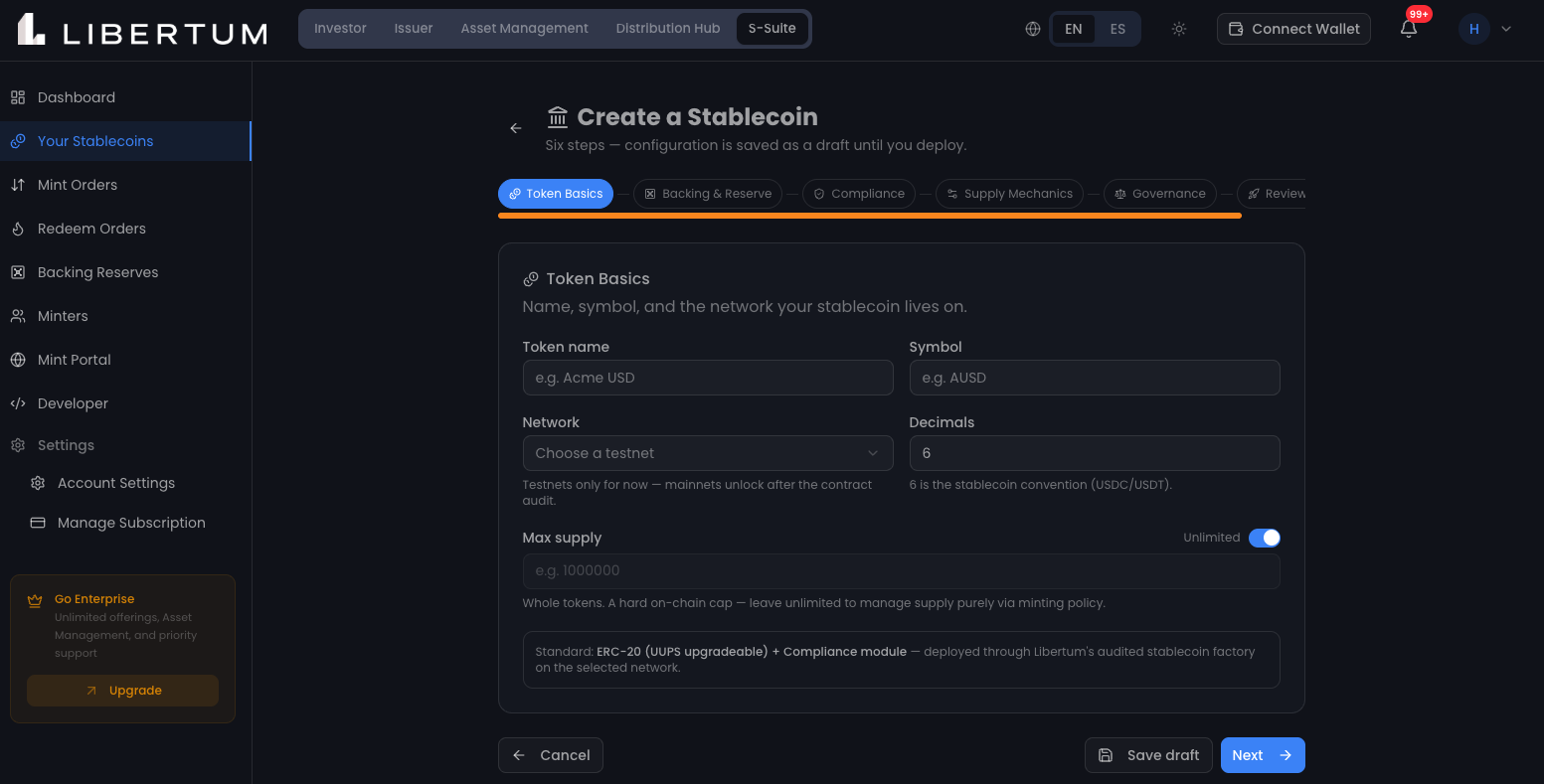
Six steps to a configured stablecoin
Name, symbol, network, and decimals, then the policy that actually matters: how it is backed, who may hold it, how supply is controlled, and who governs it. Configuration is saved as a draft until you deploy.
- Deployed through Libertum's existing audited factory — never a fresh, unreviewed contract
- Compliance module attached at issuance, with per-country rules
- Choose your mint gate: reserves-received, admin approval, or automatic
- Bring your own contract if you have already deployed one
Backing reserve
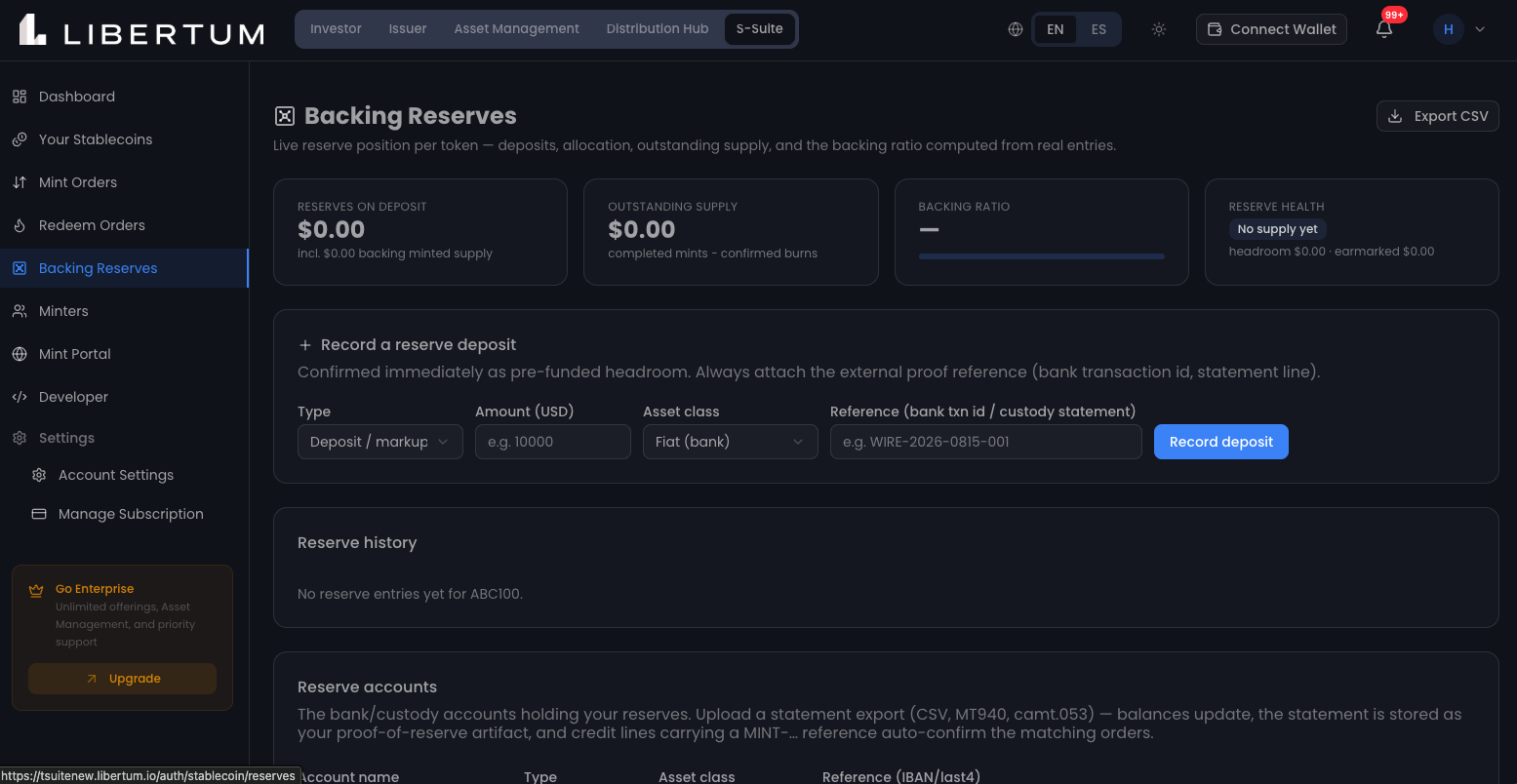
The reserve ledger is the heart of it
Reserves on deposit, outstanding supply, backing ratio, and reserve health — each computed from recorded entries, not entered as a headline figure. Deposits carry an external proof reference so every number traces back to a bank transaction or custody statement.
- Deposits and withdrawals, markups and markdowns, as signed entries
- Classify by asset class and see the true composition of your backing
- Connect bank and custody accounts, then import statements as proof
- Export the full history whenever an auditor asks
Developers
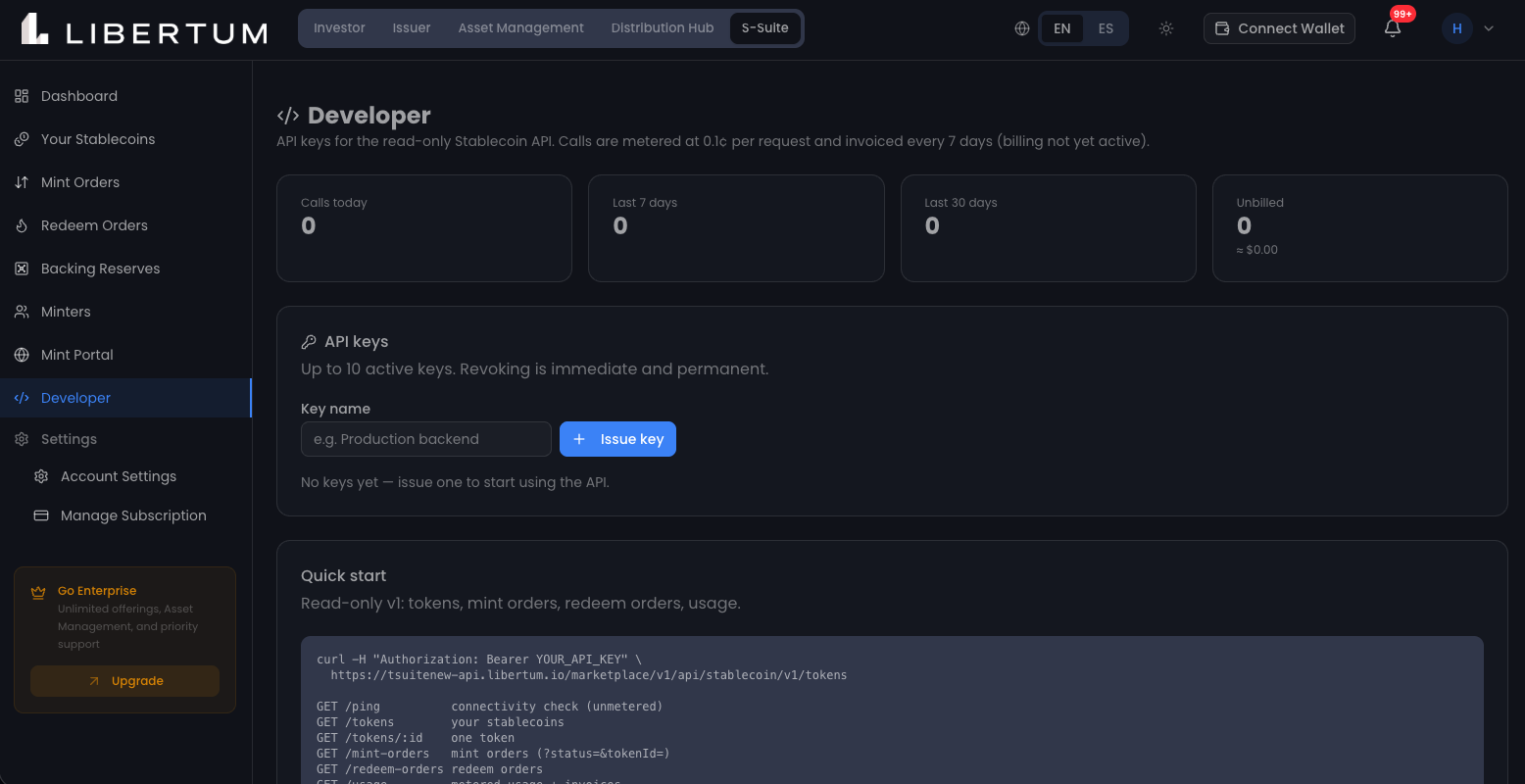
A read-only API for your own systems
Issue keys, pull tokens, mint orders, redeem orders, and usage into your treasury or reporting stack. Calls are metered transparently and invoiced on a cycle you can see.
- Up to ten active keys; the secret is shown once and revocation is immediate
- Endpoints for tokens, mint orders, redeem orders, and metered usage
- Usage counters for today, seven days, thirty days, and unbilled
- Documentation and API reference published alongside the platform
Reserve mechanisms
Backing you can demonstrate, not just assert
A stablecoin is a claim. These are the mechanics that make the claim checkable — by you, your auditor, and your supervisor.
Every asset class
Classify each entry as fiat bank deposits, treasury bills, bonds, commodities, crypto, or other — and show the real composition of your backing rather than a single number.
Backing ratio from real entries
Outstanding supply is computed as completed mints minus confirmed burns, and measured against reserves on deposit. Nothing is typed in by hand.
Valuations that move both ways
Mark commodity and security holdings to market with quantity and unit price. The change posts as a signed revaluation entry, so the reserve can fall as well as rise.
Statement import as proof
Upload a CSV, MT940, or camt.053 export. The statement is stored verbatim as your proof-of-reserve artifact, and credit lines carrying a mint reference reconcile the matching orders automatically.
Reserves-received minting
Choose the gate: mint only once reserves are confirmed, only on your explicit approval, or automatically on payment. The strictest mode means supply can never run ahead of backing.
Daily snapshots
A snapshot of every token's reserve position is written each day, giving you a dated series to publish, audit, or hand to a reviewer.
How a mint is backed, step by step
- 01
Order placed
A verified minter requests tokens and is quoted a fee before committing.
- 02
Payment received
Wire, card, or stablecoin. Bank credits reconcile automatically when the reference matches.
- 03
Reserve confirmed
The deposit is recorded against a reserve account and earmarked to that order.
- 04
Tokens minted
Only then does supply increase, and the transaction receipt is verified on-chain.
Redemption runs the same sequence in reverse: the holder redeems against a registered payout account, tokens burn on settlement, and the released reserve returns to unallocated headroom.
Regulation & law
Built for the rules stablecoins are now written under
Stablecoin issuance moved from grey area to statute across major markets. The obligations converge on the same handful of themes — and the platform is shaped around them.
European Union
MiCA — Regulation (EU) 2023/1114Splits tokens into e-money tokens referencing one official currency and asset-referenced tokens. E-money token issuance is reserved to authorised credit or electronic money institutions, with segregated reserves, a published whitepaper, and redemption at par at any time.
United States
GENIUS Act (2025) and state regimesA federal framework for payment stablecoins alongside existing state money transmitter licensing. New York's DFS guidance has long set the practical bar: full backing by cash and short-dated treasuries, segregated reserves, monthly attestation by an independent accountant, and timely redemption.
Singapore
MAS stablecoin frameworkSingle-currency stablecoins must hold low-risk, highly liquid reserves at or above par, meet base capital requirements, and return par value to holders within five business days of a redemption request.
United Kingdom
FCA and Bank of England regimeA regime for fiat-backed stablecoins used in payments, covering backing asset quality, statutory trust arrangements over reserves, and redemption rights, with systemic payment chains supervised by the Bank of England.
Hong Kong
Stablecoins OrdinanceA licensing regime for issuers of fiat-referenced stablecoins, requiring full reserve backing with segregation, redemption at par, and local presence.
El Salvador
Digital Assets Issuance LawDigital asset service providers and issuers register with the CNAD, which supervises issuance, custody, and exchange activity under a purpose-built digital assets statute.
A note on responsibility. Libertum provides issuance technology and reserve infrastructure. It does not issue your stablecoin, hold your reserve, or provide legal advice, and using the platform does not itself confer any licence or registration. Requirements differ by market and change often; the summaries above are general information as at 2026 and no substitute for qualified advice in the jurisdictions where you and your holders sit.
Controls that map to those obligations
Identity before value
KYC for individuals and KYB for entities, with per-country rules. Minters who are not verified to your standard never reach the mint form.
Wallet whitelisting
Customers register a wallet and you approve it. Optionally refuse to mint to any address that has not been whitelisted for your token.
Transfer controls
Freeze an address, pause the token, and force-transfer where your legal framework requires it — the standard supervisory powers, exposed as controls rather than promises.
Redemption at par
Holders redeem back to fiat against a payout account they registered, and the tokens burn on settlement. Redemption is a first-class flow, not an email address.
Custody & security
Keys, signing, and settlement
Most customers never want to hold a private key. Custody is built in, so your minters can hold a balance without running a wallet — and you keep the controls.
Custodial keys, properly handled
Keys are derived per user, chain, and network and sealed with AES-256-GCM under a master key. Export requires a two-person ceremony that is recorded.
Signing controls
Signing can be paused globally or per chain from the admin console — an immediate stop on all mints, burns, and deploys if something looks wrong.
Verified on-chain results
Mints and burns are confirmed by reading the transaction receipt before an order is marked complete, so the ledger reflects the chain rather than an intention.
Multi-chain issuance
Cardano mainnet is live for real-money issuance today. EVM networks are available for testing, with mainnet enabled as each contract audit completes.
Your customers
A Mint Portal on your own domain
The portal is where holders actually live: buy, redeem, see balances, register wallets and payout accounts, and follow every order. It carries your brand, not ours.
Your domain
Run the portal on a dedicated mint domain, inside your white-label marketplace, or both — chosen per token.
Three ways to pay
Wire transfer to the bank accounts you nominate, card payment, or USDC and USDT.
Full account view
Balances per token, whitelisted wallets, payout accounts, and complete mint and redemption history.
Pricing
Three tiers, priced to start small
Starter
$19.99per month
- One stablecoin
- Test networks
- Up to $100k monthly mint volume
Growth
$49.99per month
- Three stablecoins
- Cardano mainnet issuance
- Dedicated mint domain
- Up to $1M monthly mint volume
Enterprise
$199.99per month
- Unlimited stablecoins
- All supported networks
- Custom mint volume
- Priority support
Per-transaction fees, KYC verifications, and metered API calls are billed on usage. Gas on supported test networks is covered by the platform.
Questions
What issuers ask first
- Do I need a licence to issue a stablecoin?
- Almost certainly, and it depends on where you and your holders are. A token redeemable for one official currency is regulated activity in most major markets. Libertum supplies the issuance, reserve, and compliance infrastructure; obtaining and holding the authorisation is the issuer's responsibility, and you should take your own legal advice before you launch.
- Who holds the reserve?
- You do. Reserves sit in your own bank, custody, and commodity accounts. The platform records, classifies, reconciles, and reports on them — it never takes possession of your backing assets.
- What backs the token?
- Whatever you register and prove: bank deposits, treasury bills, bonds, commodities such as gold, crypto, or a mix. Composition is shown per class, and non-cash holdings are marked to market so the reported reserve reflects present value rather than purchase price.
- Can supply ever exceed the reserve?
- Not if you use reserves-received minting, which holds each order until its backing is confirmed and earmarks that reserve against it. Backing ratio and unallocated headroom are visible at all times.
- Which networks can I issue on?
- Cardano mainnet is live for production issuance. Ethereum, Base, Polygon, Arbitrum, BNB Chain and Avalanche are available on test networks, with mainnet unlocked per network as contract audits complete.
- How do my customers buy and redeem?
- Through a Mint Portal you brand and host on your own domain, or listed inside your white-label marketplace, or both. They pay by wire transfer, card, or USDC/USDT, and redeem back to a payout account they have registered with you.
Looking for the technical detail? Documentation and the API reference are published with the platform, and the team can walk your engineers through integration. See the wider Libertum platform.
Launch a stablecoin your holders can verify
Configure it in an afternoon, fund the reserve, and open the portal to your customers.