


Modular, Flexible Tools.
Real-World Tokenization, Simplified
Because every asset, client, and market requires a tailored approach.
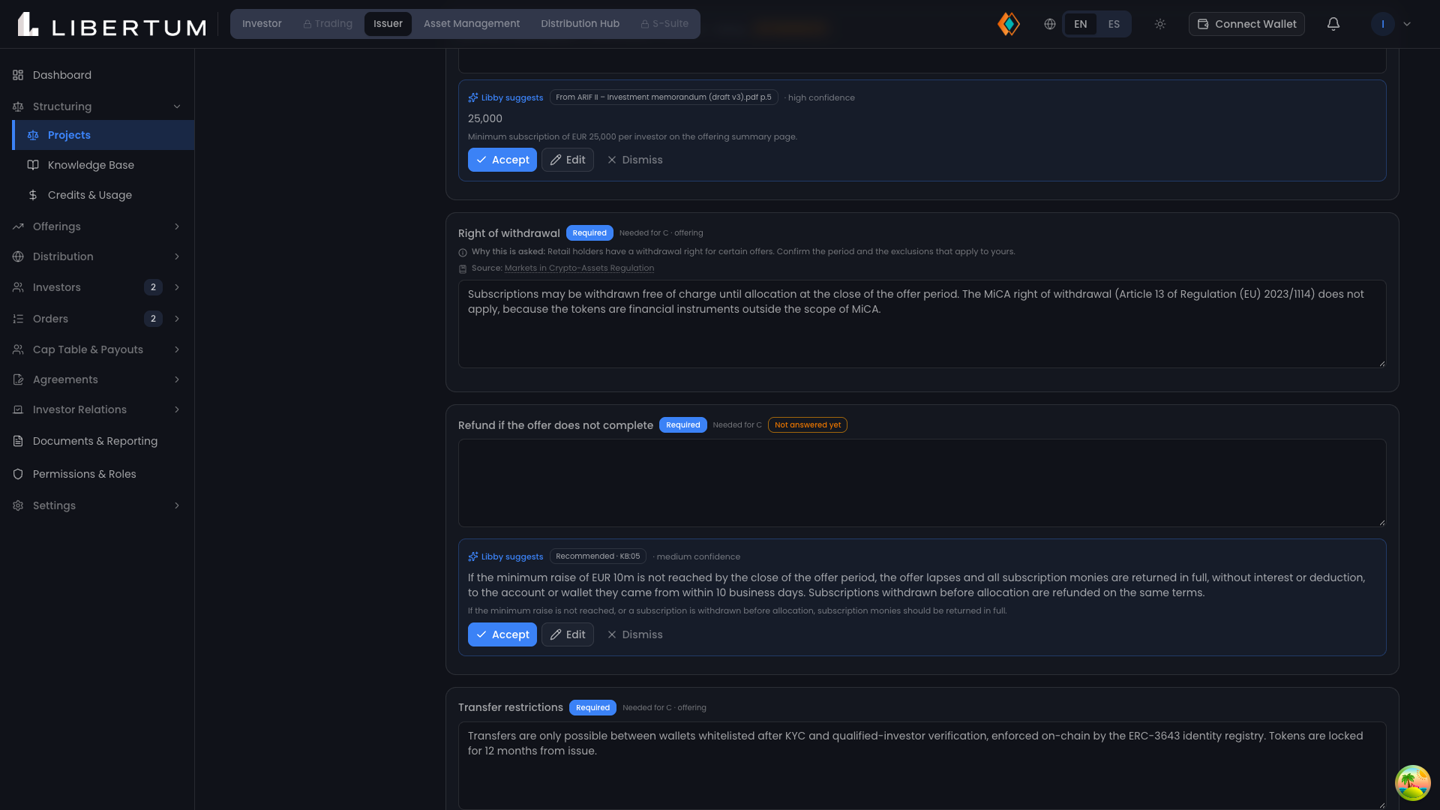
Prepare your offering pack with regulatory packs for El Salvador (CNAD), the US (SEC), the EU (MiCA / MiFID II) and the Cayman Islands (CIMA). Libby proposes answers with sources, drafts cited documents and tracks every artefact for your counsel.

Libertum — Your Gateway to the Tokenized Economy
Built for innovators. Trusted by institutions. Engineered for what’s next.
The future of investment is on-chain. Libertum transforms the way institutions handle real-world assets by offering a complete tokenization suite that is secure, transparent, and ready for scale. Whether you’re tokenizing real estate, raising capital, or offering fractional investment access, our infrastructure helps you:
From setup to scale, we make tokenization seamless so you can focus on what matters—building the future of finance.

Investor: Invest in verified real-world assets
Browse a marketplace of verified offerings, choose an amount and see exactly what you will receive before you commit.
Sign the subscription agreement electronically with a one-time code, pay by bank transfer with clear instructions and a unique reference, then follow your holdings, distributions and issuer updates in one place.
-
-
-
Transcript: Investor experience demo
Investing in private assets usually means PDFs, wire instructions and long silences.
Investors can't see what they own, when they'll be paid, or how to get out. And issuers lose them along the way.
On Libertum, investors start in a marketplace of verified offerings, with the terms, yield and documents in one place.
Anna picks Rotterdam Logistics Park, chooses her amount, and sees exactly what she'll receive before she commits.
The subscription agreement is part of the flow. She reads it and signs it electronically, with a one-time code.
Then she pays by bank transfer, following clear instructions. No email chains.
Once her tokens are minted, the holding appears in her portfolio, with its value and status.
Every distribution is recorded as it is paid, so she sees each payment and what is coming next.
When she wants to exit, she requests a redemption in an open window, at a known price.
And every update from the issuer lands in one inbox.
For funds, asset managers and fund administrators: give your investors this experience, under your own brand. Book a demo at libertum.io.
Issuer: Run your offering end to end
Create an offering step by step: the asset, its financial terms, the token standard and the chain.
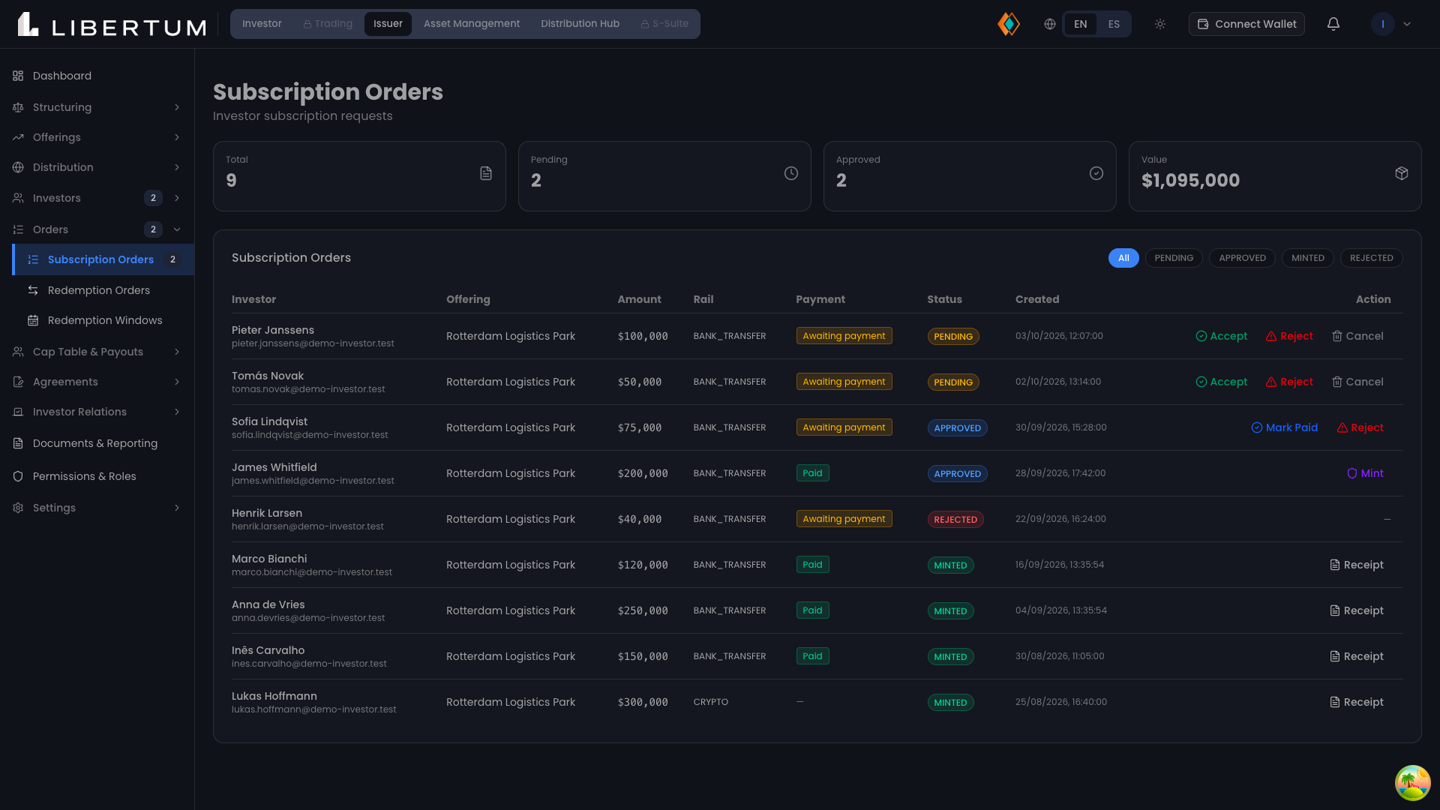
Then run day-to-day operations from one console: accept orders, confirm payments and mint tokens in a single queue, keep a cap table that updates itself, and handle NAV updates, redemptions and payouts.
-
-
-
Transcript: Issuer operations demo
Raising capital is only half the job. Running the offering afterwards is where it gets messy.
Orders in spreadsheets, a transfer agent for the cap table, lawyers for every compliance action, and investors waiting on updates.
On Libertum, you create the offering step by step: the asset, the financial terms, the token standard and the chain.
Subscription orders arrive in one queue. You accept the order, confirm the payment, and mint the tokens to the investor.
Your cap table updates itself. Open any holder to see their position and the compliance controls.
Freeze a wallet, unfreeze it once resolved, or recover tokens when a regulator requires it, all enforced on-chain.
When the asset is revalued, you update the NAV, and investors see the new price.
When investors want to exit, you open a redemption window with a set price and capacity.
Requests come to you to approve, settle and record the payout.
For funds, asset managers and fund administrators: run the whole offering lifecycle in one place. Book a demo at libertum.io.
Structuring: Structure your deal before you tokenise it
Pick a regulatory pack (El Salvador CNAD, EU MiCA / MiFID II, US SEC Reg D / Reg S, or Cayman Islands CIMA), describe the deal and upload what you already have. Libby proposes intake answers with their sources, and you accept, edit or dismiss each one.
Track readiness phase by phase and generate draft documents that cite the facts and rules behind each section, ready for review by your counsel.
-
-
-
Transcript: Structuring demo
Before you can tokenise an asset, you have to structure it.
That usually means months of lawyers, templates and back-and-forth, before a single investor sees the offering.
In Structuring, you start a project and pick the regulatory pack: El Salvador's CNAD, Europe's MiCA, or the United States.
Describe the deal in plain language, and upload what you already have.
Libby reads it and fills in the intake for you. Every value comes with its source, for you to accept, edit or dismiss.
Readiness shows what's complete and what's still missing, phase by phase.
Then Libby drafts the documents the pack requires, citing the facts and the rules behind each section, ready for your counsel.
The checklist tracks every artefact, including the platform policies you sign electronically.
Share a secure link with your lawyer to review and comment, without creating an account.
When it's ready, one click turns the project into an offering.
For funds, asset managers and fund administrators: go from asset to offering pack in days, not months. Book a demo at libertum.io.
Distribution Hub: Find the investors behind your next raise
Investor activity on your offerings (views, interest and investments) becomes intelligence in your Investors CRM. Libby researches your target market for real firms and decision-makers, with every fact sourced.
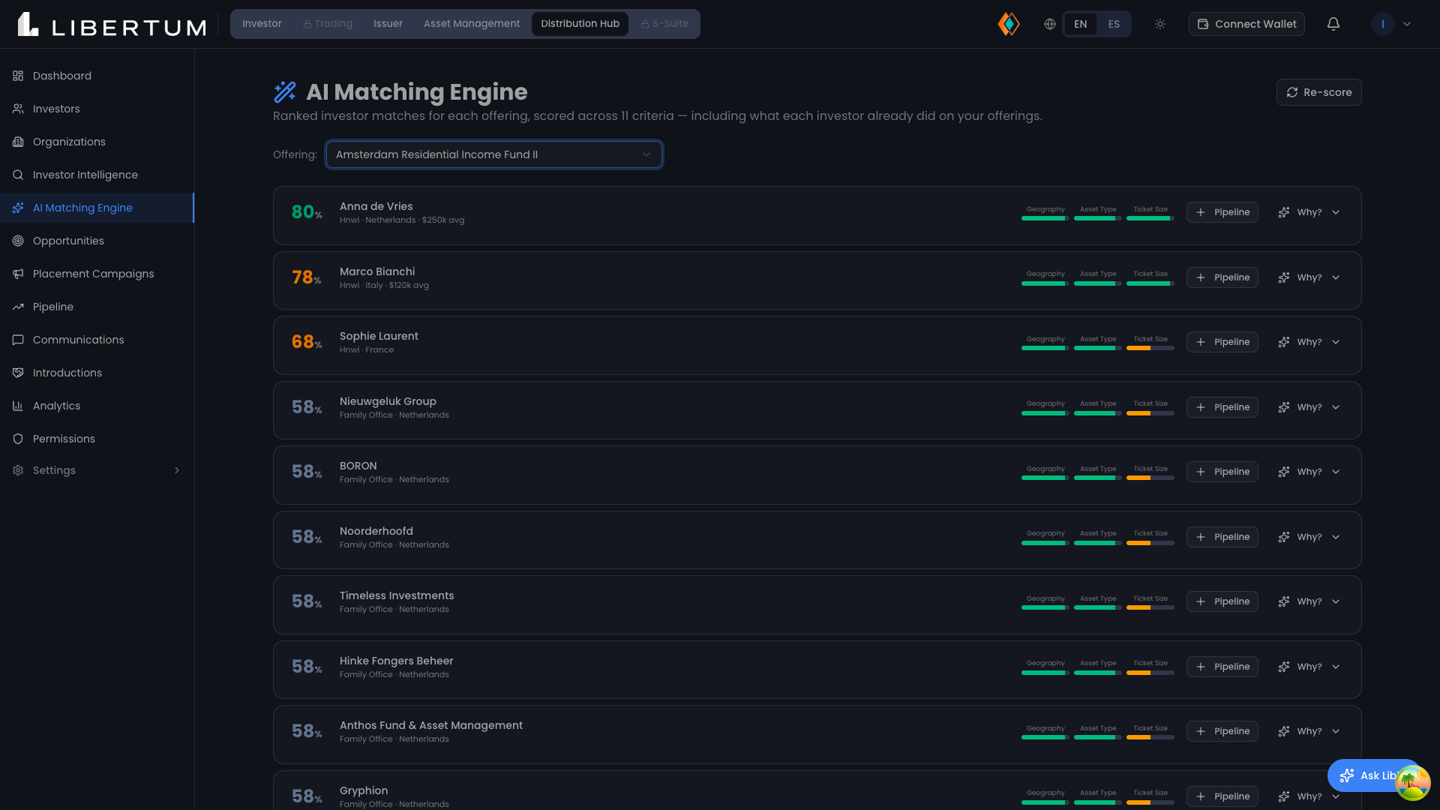
AI matching ranks investors for your next offering, including those who invested in similar assets, and outreach briefs tell you why each one fits, who to approach, when and what to send.
-
-
-
Transcript: Distribution Hub demo
You can tokenise an asset in weeks. Finding the right investors for it is another story.
For most issuers, distribution happens in the dark. Who is interested, what they have already invested in, who to call next. It is guesswork, scattered across inboxes, spreadsheets and memory.
On Libertum, every interaction with your offerings is a signal. When an investor views an offering, registers interest in one that is coming soon, or invests, the platform records it, against that investor, for you.
Investor Intelligence turns those signals into a living profile, automatically, inside your Investors CRM. No exports, no separate analytics tool. Investors who have invested with you, and those warming up, are flagged right in your list.
Open any investor and you see the story. What they viewed, what they registered for, how much they invested and in what, their average ticket, and the asset classes they lean towards.
And to find investors you do not know yet, Libby researches the market for you. Real firms, the key decision makers, published contact details, and whether they are open to tokenised assets. Every fact comes with its source.
Now you are launching your next offering. Matching ranks every investor in your CRM by fit, and someone who already invested in a similar asset rises straight to the top.
Libby then tells you why they fit, who to approach, when, and what to share. Your offering page, your deck, and what to keep for after an NDA. Drafted for you, never sent without you.
From signal, to intelligence, to the right conversation. One place to understand every investor, and act on it.
For funds, asset managers and fund administrators. Stop guessing who to target. Book a Distribution Hub demo at libertum dot io.
Asset Management: Manage the assets behind your tokens
See your whole portfolio in one view: value, performance and what needs attention. Every asset has a registry entry with its type, status and lifecycle stage, and a workspace for its financials, documents and linked offering.
Plan maintenance and work orders, track compliance requirements against an audit log, and produce reports for clients and investors.
-
-
-
Transcript: Asset Management demo
Tokenisation starts with the asset, and the asset has to be managed.
But asset data lives in spreadsheets, inboxes and separate systems, cut off from your investors and your reporting.
Asset Management in T-Suite gives you one view of your whole portfolio: value, performance and what needs attention.
Every asset sits in the registry, with its type, status and lifecycle stage.
Open an asset to see its workspace: financials, documents and the offering it's linked to.
Track maintenance and work orders, so nothing slips between owners, tenants and contractors.
Compliance requirements and an audit log keep every obligation visible and every change recorded.
Generate reports for clients and investors from the same data.
And when you're ready, the Tokenization Bridge turns a managed asset into an offering in a few clicks.
For funds, asset managers and fund administrators: manage, report and tokenise from one platform. Book a demo at libertum.io.
Funds: Fund administration, on-chain. Run by you.
White-label infrastructure for fund administrators. You remain the NAV calculation agent and the transfer agent; T-Suite imports your NAV and register, enforces your rules, publishes on-chain, reconciles and exports.
One administrator serves many fund managers, each fund chooses its approvers, and every NAV is published with the pack’s SHA-256 hash so anyone can verify it.
-
-
-
Transcript: Funds demo
Fund administration still runs on spreadsheets, email threads, transfer-agent exports and bank statements in PDF.
Every NAV, every dealing day and every reconciliation passes through hands, files and inboxes, with nothing proving who checked what.
T-Suite Funds gives fund administrators one place to run it all, on-chain and under their own brand. The administrator stays the NAV calculation agent and the transfer agent. T-Suite imports, enforces, publishes and reconciles.
Funds is available on request. A firm opens Manage Subscription, finds the Funds card at one thousand US dollars a month, and clicks Request access.
They tell us about the firm: its name, website, country, and the funds it runs.
The request is sent, and the Libertum team is told straight away.
Libertum agrees the terms with you, including the distribution fee, and grants the module. Your operator workspace is created automatically, named from what T-Suite already knows about your firm.
The Funds tab is the administrator's home: every client fund manager, every fund and share class, and the last NAV published for each.
Funds can be open-ended or closed-ended, in any currency, each with its own NAV frequency.
Invite your team with clear roles: preparers do the work, approvers check it, and auditors only read. Access can be limited to one fund, and auditors always get an expiry date.
Each fund chooses how many people approve its work: one person, or two, three or four. Freezes, forced transfers and wallet recoveries always need two people.
Investor payment details live with the fund: a bank account and a USDC address, with optional overrides for each share class. Changes take effect only once approved.
Calendars set the business days and holidays behind every NAV deadline and dealing date.
And your branding appears on fund pages, contract notes, notices and emails.
Share classes can be linked to a token issued on T-Suite. From then on, that token is managed by the fund.
On the issuer's side, the offering shows that it is managed in Funds.
And investors see Subscribe through the fund instead of a buy button, so nobody can trade around the fund's rules.
Now, the NAV. The administrator calculates it. T-Suite checks it, gets it approved, and publishes it.
The preparer imports the administrator's file. T-Suite checks every class, the currency, the units against the register, and the move since the last NAV. Here, class B moved more than the five percent tolerance.
A breach can't be waved through: it needs a written reason. Then the pack goes for approval, with a note for the approver.
The pack gets a fingerprint of its lines and files, and waits for approval under the fund's setting.
The approver sees exactly what they are signing, with the reasons and the payload hash. On a one-person fund, the preparer approves it themselves, and that is recorded too.
Once approved, each class's NAV is published on-chain with the pack's fingerprint, and anyone can recompute it to verify the record.
Dealing, for open-ended funds.
It starts with the dealing terms: cut-off times, notice, settlement, fees, minimum holdings, lock-ups and redemption gates. Changes are approved like everything else.
Investors subscribe from the offering page, by amount or by units. Orders are forward priced at the NAV of the dealing date, which is not known yet.
The order is received with its dealing date and a payment reference, and exactly how to pay: the fund's bank account or its USDC address.
The same details stay in the investor's dashboard, under My fund orders, and arrive by email. Investors can also pay straight from their USDC balance, after the usual security checks, and the order is marked paid only when the exact amount arrives.
Orders from the administrator's own transfer-agent system come in by file or through the API, next to orders placed on T-Suite. Cash is marked received before the cut-off.
After the cut-off and the NAV, the preparer builds the dealing run: units for every order, fees, and any gate applied pro rata.
Once the run is approved, units are minted and burned on-chain, and every investor gets a contract note.
Closed-ended funds work through commitments.
Investors commit capital, and a closing issues units in proportion to each commitment.
Capital calls are split across investors automatically, with a notice for each, and payments tracked line by line. Distributions break down into return of capital, income and gains, with withholding.
Capital accounts follow the ILPA layout: committed, contributed, unfunded and distributed, for any period, and export to CSV.
Investors see the same capital account, every call and every distribution notice, in their own dashboard.
Then, reconciliation.
Reconciliation compares three records: the on-chain register, the administrator's register and the bank statement. Each break has an age and an owner.
Payments match only for the exact amount. A short payment becomes a break, never a silent match, and an unknown payment waits for a person to pair it.
Libby, the AI assistant, can suggest pairings with its reasons, but never applies them. A person confirms, and the reconciliation is signed off through approval.
Journals map every event to the administrator's chart of accounts, as balanced batches for the general ledger, exported once approved.
Enforcement covers freezes, forced transfers and wallet recoveries. Each needs a written reason and a second person, always.
Any file from the administrator's system can be dropped in, with saved column mappings, and an outbox prepares register, dealing, capital-account and journal files on a schedule.
Integrations connect the administrator's own systems through the Funds API: scoped keys, limited to chosen funds, each acting for a named person.
That person must accept a key before it works, because everything it does is attributed to them.
Signed webhooks push events to your systems, with retries. Developers also get a software kit, a command line, and an AI assistant connector that can read and prepare, but never approve.
Every change, decision and access is in a tamper-evident access log. Verify the chain at any time, and build an evidence pack for the auditors in one click.
And investors see their fund holdings at the latest published NAV, next to their orders and contract notes.
T-Suite Funds: run every fund you administer in one place, on-chain, under your brand. One thousand US dollars a month, with unlimited funds. Request access in T-Suite, or book a demo at libertum dot io.
Start your tokenization
Find your path from asset to investors
Answer a few quick questions and see which stages and Libertum modules fit your project. Then send it to our team or book a call. It takes about two minutes.
Step 1 of 7
What do you want to tokenize?
Choose the asset class that best describes your project.
How we recommend Libertum modules
The tokenization wizard above recommends modules from your answers using these rules.
| Module | Recommended when | Stage |
|---|---|---|
| Structuring From asset to offering pack, drafted for review by your counsel. | Your stage is “Just exploring” or “Asset identified, no structure yet” or “Structure / legal work underway” — there is no finished legal structure yet. | Structuring & Issuance |
| T-Suite Issue and run the offering from one console. | Every project that is not yet tokenized; if it is “Already tokenized”, when your goals include “Raise capital”, “Fractional ownership”, “Automate compliance & investor management”, “Offer liquidity / secondary trading to existing investors”. | Tokenization |
| White-label branding Your own branded investment platform, powered by T-Suite. | Your goals include “Launch a branded investment platform”. | Tokenization |
| Distribution Hub Find and reach the investors who fit your offering. | Your goals include “Raise capital” or “Reach new investors & distribution” or “Offer liquidity / secondary trading to existing investors”, or the asset is “Already tokenized”. | Distribution |
| Asset Management Operate tokenized assets after launch. | Your goals include “Manage and report on assets”, or the asset is “Already tokenized” and you want “Automate compliance & investor management” or “Offer liquidity / secondary trading to existing investors”. | Asset Management |
| Funds Fund administration on-chain, for administrators and the managers they serve. | The asset is “Fund units / investment fund” — Funds is then listed first. | Asset Management |
Structuring regulatory packs by jurisdiction: El Salvador: CNAD · United States: SEC · European Union: MiCA · MiFID II · Cayman Islands: CIMA.
Choose the Token Standard that Fits Your Asset

Regulated security tokens with on-chain identity and compliance

Programmable regulated tokens on Cardano

Issued currencies and XLS-33 MPTs with authorised holders on the XRP Ledger

Unique NFTs for one-of-a-kind assets

Fungible tokens for DeFi
Already issued elsewhere?
Switching platforms? We've made it easy.
Bring a token you have already issued on another platform into T-Suite, with its holders, its history and its contract intact.
- Bring your existing token ERC-3643, ERC-20 and ERC-721 on EVM chains, CIP-20 and CIP-113 on Cardano, and issued currencies and MPTs on the XRP Ledger.
- Prove it's yours with one signature You sign a single message to show you control the token. Nothing is transferred, minted or moved.
- History and cap table, checked against the chain T-Suite rebuilds the full on-chain history and cap table, and only publishes it once it matches the chain exactly.
- Keep your contracts Grant Libertum roles on your own contract only when you want it to operate it, and let your investors claim their holdings.
On EVM chains, granted roles let Libertum issue to new investors, run compliance actions and list the token for sale. Cardano and XRP Ledger imports are read-only.
Transcript: Token Import demo
Already issued a token elsewhere? Bring it with you.
Switching platforms usually means a migration, a re-issue and a holder spreadsheet.
Imported tokens lists everything you've brought in, on EVM chains and the XRP Ledger.
Pick the network, paste the contract, and Libertum reads the standard, name and supply from the chain.
Prove control: your on-chain role is found, you sign one message, and nothing on the contract changes.
Name the offering and import it.
The history is rebuilt from the chain and checked against it. The cap table is live.
Every transfer is in the journal, with pre-import entries marked external.
Investors claim their holdings: Anna signs once from her wallet, and her tokens never move.
The holding appears in her statements, read from the chain.
Your contracts stay yours. Libertum starts read-only and lists the roles to grant.
On EVM, grant them from your wallet and the token moves to Operate: issue, freeze, register identities, list for sale.
XRP Ledger and Cardano tokens import read-only, and history that can't be rebuilt is flagged.
For issuers and fund administrators: bring your tokens, and run them in one place. Book a demo at libertum.io.
Real client stories
- LandHive A Zürich-based prop-tech company helping real estate developers tokenize projects and raise development capital, through a white-label portal on its own domain. Real estate developmentsSwitzerlandWhite-label T-Suite portal.landhive.io
- LiquidHectare Fractional ownership of land, with an investor and issuer portal on its own domain built on Libertum's white-label T-Suite. Land / fractional real estateUAE & South AfricaWhite-label T-Suite app.liquidhectare.com
- GROTTO A US tokenization firm for private real estate, funds and private equity, running its investor and issuer portal on white-label T-Suite. Real estate, funds, private equityUnited StatesWhite-label T-Suite invest.grottoglobal.com
Earn Yield and Trade Anywhere, Anytime

Explore our T-Suite Offerings


Use the form below to book a call or leave us a message to get back to you as soon as possible.