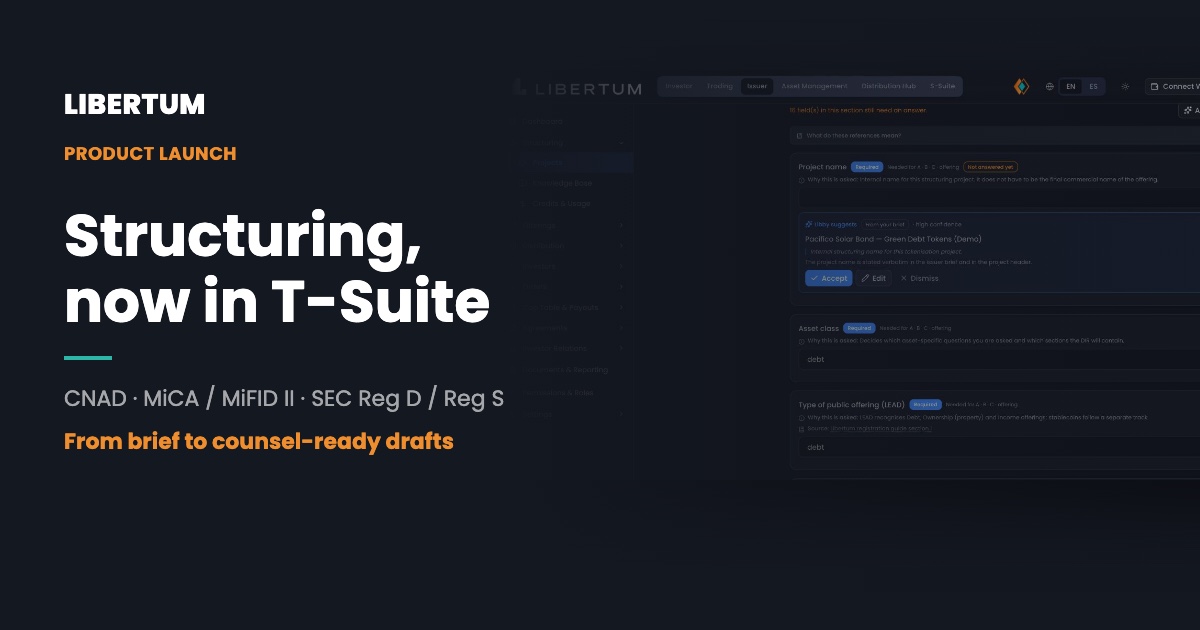
Bringing a real-world asset on-chain is rarely held back by the technology. It is held back by the paperwork: the evaluation, the structure, the registration file, the sworn statements, the policies the regulator expects to see, and the months of back-and-forth it takes to assemble them.
Structuring is a new T-Suite module that turns that process into a guided workflow.
What it is
Structuring is document-preparation software built into the Issuer workspace of T-Suite. You open a project for each issuance. T-Suite walks you through what your chosen regulatory framework requires, helps you answer it, and drafts the documents from your answers.
It is built on Libertum’s regulatory knowledge packs: structured, cited summaries of what each framework requires.
| Pack | Framework | Legal basis covered |
|---|---|---|
| El Salvador | CNAD (LEAD) | Ley de Emisión de Activos Digitales; issuer and issuance registration rules; public-offering rules |
| European Union | MiCA / MiFID II | MiCA (EU 2023/1114); MiFID II (2014/65/EU); Prospectus Regulation (EU 2017/1129); DLT Pilot Regime (EU 2022/858) |
| United States | SEC Reg D / Reg S | Securities Act §4(a)(2); Reg D Rules 501–506; Reg S; Rule 144; Form D |
How it works
- Create a project. Choose the jurisdiction, asset class, offering type and placement. These decide which questions apply: an EU project asks about asset-referenced and e-money tokens, a US project about Reg D exemptions.
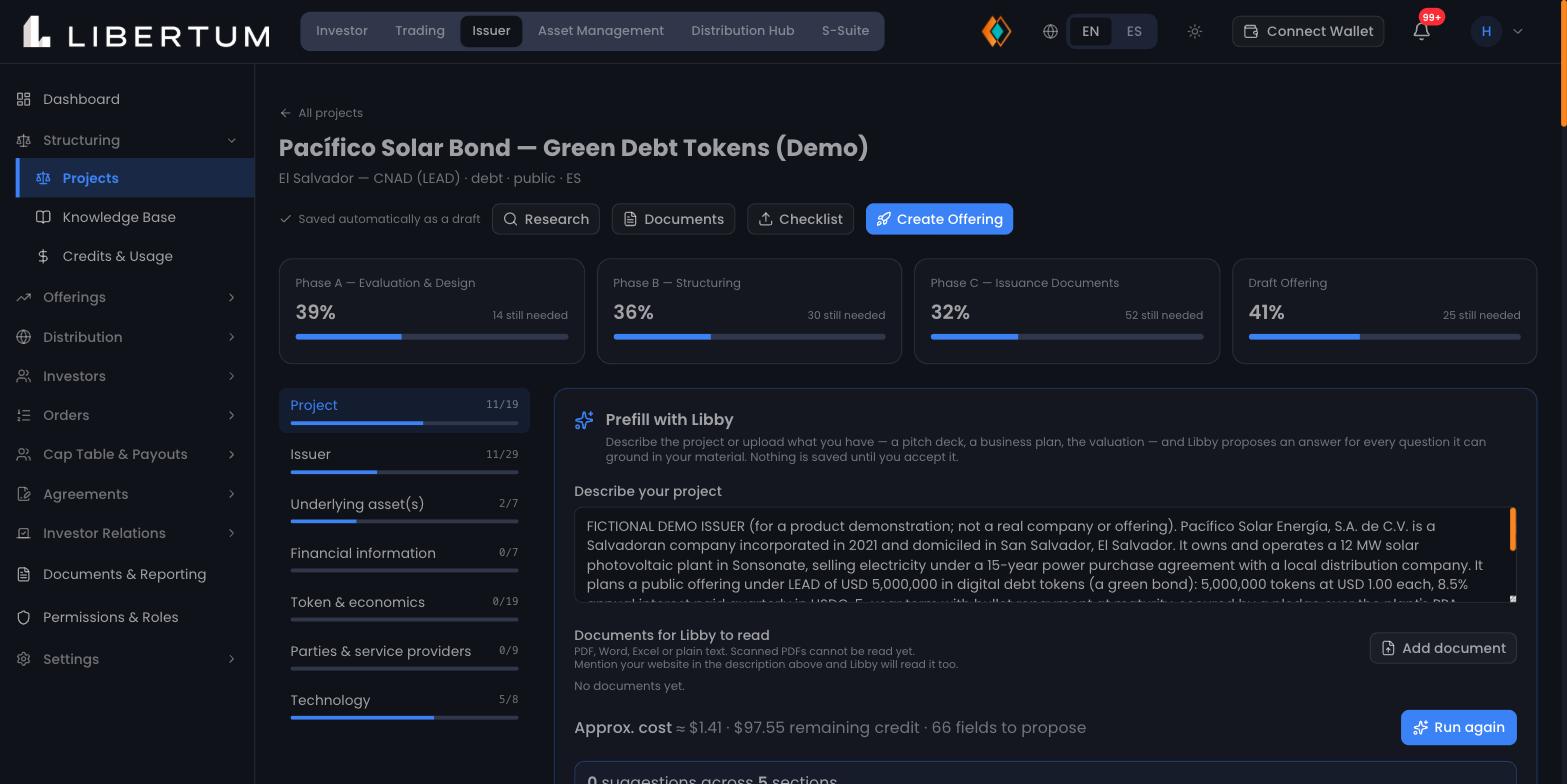
- Brief Libby. Describe the issuance in plain words and add your pitch deck, business plan or valuation. Libby, our AI, reads the jurisdiction’s knowledge base, your website and your documents.
- Review Libby’s proposals. For every question she can ground in your material, Libby proposes an answer, marked with its source (“from your brief”, “from your deck”) and a confidence level. Accept, edit or dismiss each one. Nothing is saved until you accept it.
- Watch readiness climb. Each phase (A: Evaluation & Design, B: Structuring, C: Issuance Documents) shows how complete it is and what is still needed.
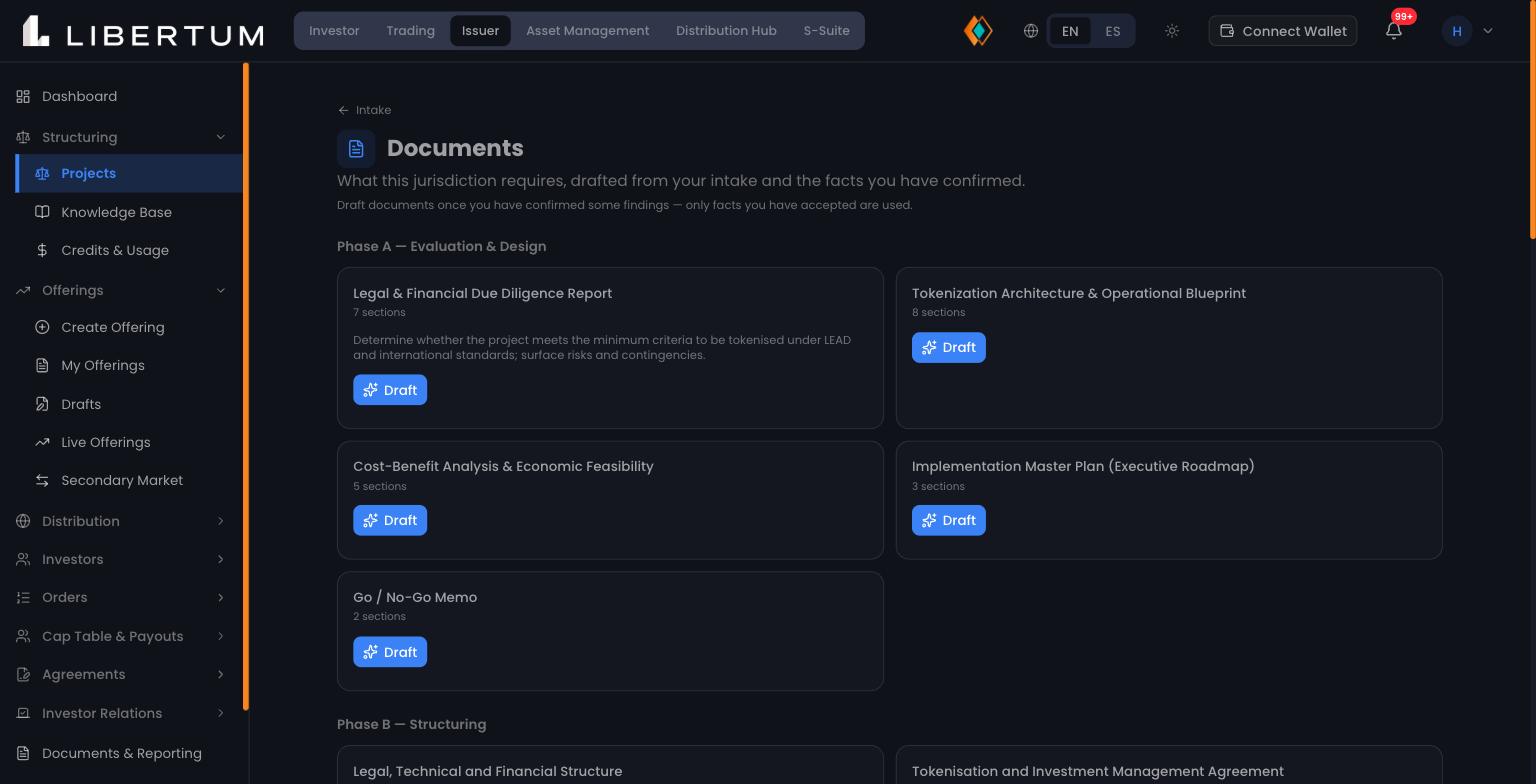
- Generate the documents. T-Suite drafts the full set for your framework. For CNAD, that is twenty-one documents, from the due-diligence report to the issuer and issuance registration applications, in the filing language with a translation alongside.
- Hand it to counsel and file. Export the drafts and the registration checklist, have your lawyers review them, and create the offering in T-Suite when you are ready.
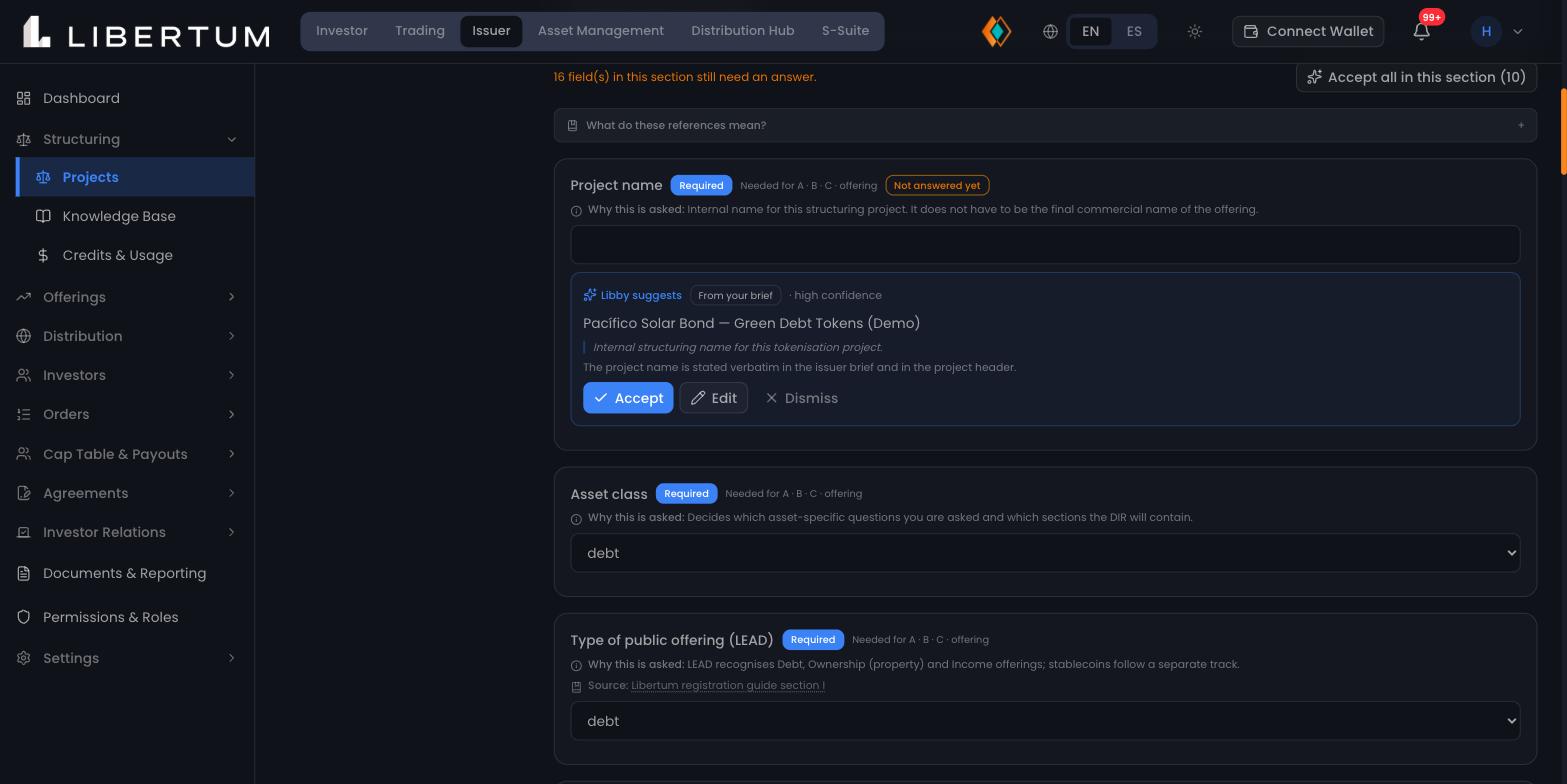
Every question explains why it is asked and cites the article or annex behind it. Every proposal says where it came from. You stay in control of every answer that reaches a document.
Why it matters
- Cost. A traditional advisory-led structuring engagement runs into tens of thousands of dollars before a single token is issued. Structuring is a monthly subscription, up to 80% less.¹
- Time. The first complete draft set takes hours, so counsel reviews a finished draft instead of starting from a blank page. A process that typically takes around three months can reach a counsel-ready document set in around three days.²
- Consistency. Every answer is written once and reused across every document, so the registration file, the terms and the policies never contradict each other.
- Traceability. Every question cites the article behind it, and every AI proposal says where it came from.
A worked example
In our demo we set up Pacífico Solar Bond, a fictional Salvadoran solar company raising USD 5 million in digital green-bond tokens under LEAD. From a one-paragraph brief, Libby proposed answers across the project, issuer, asset, financial and token sections in minutes, and the CNAD registration set was drafted from them.
Getting started
Structuring is available to issuers as a T-Suite add-on. See the add-on on our plans page, or sign in to T-Suite and open Issuer → Structuring → Projects.
Your lawyers review. You file. We handle the paperwork in between.
¹ Cost. Compared with Libertum’s own advisory-led structuring service (Phase A evaluation and design, USD 4,500; Phase B structuring and registration, USD 25,000). Structuring is USD 500 per month plus AI usage. Your own legal counsel’s review is additional and is not included in either figure.
² Time. Indicative, based on Libertum advisory engagements. Actual timing depends on the issuer’s documents and on counsel review.
Structuring prepares draft documents for review by your own legal advisers. It is not legal advice, and it does not file with, or submit to, any regulator on your behalf. Regulatory knowledge packs are in beta pending review by counsel qualified in each jurisdiction. Libertum is licensed by El Salvador’s Comisión Nacional de Activos Digitales (CNAD) as a Digital Asset Service Provider; that licence confers no authorisation in other jurisdictions. The example issuer is fictional.